PDF
Capability Statement
A concise overview of ClearRoot Materials expertise, services, and approach.
Download PDFClearRoot shares practical knowledge on polymer failure analysis, materials characterization, contamination investigations, and analytical techniques so manufacturers, engineers, and technical decision makers can ask better questions and make more informed decisions.
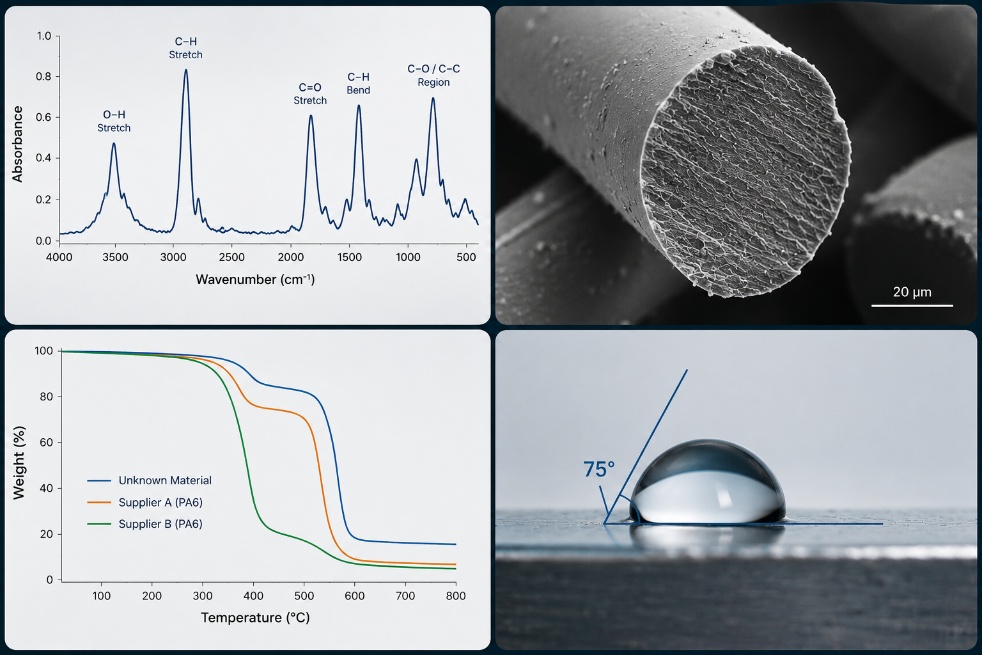
Each technique provides a different type of evidence. ClearRoot helps clients understand what a method is commonly used for, what question it can help answer, and how the results fit into the larger investigation.
Helps identify materials and chemical functional groups. Commonly used to compare polymers, adhesives, coatings, residues, and contamination.
Provides high magnification surface images and elemental information. Useful for fracture surfaces, debris, foreign particles, and contamination questions.
Measures thermal transitions such as melting, crystallization, and glass transition. Helpful for material comparison, formulation differences, and processing questions.
Measures weight loss as a material is heated. Helps evaluate filler content, thermal stability, moisture, volatiles, and decomposition behavior.
Measures how a material responds to stress, temperature, and frequency. Useful for stiffness, damping, and temperature dependent performance questions.
Breaks down complex materials into chemical fragments for analysis. Useful for polymers, rubbers, adhesives, coatings, and unknown organic materials.
Screens for elements in a material or surface without extensive sample preparation. Helpful for fillers, metals, inorganic additives, and contamination checks.
Measures how materials absorb or transmit light. Useful for discoloration, optical changes, coatings, dyes, and stability questions.
Investigations begin with the problem, not the instrument. ClearRoot first defines the decision that needs to be supported, then selects analytical methods that can provide relevant evidence.
What failed, where did it fail, when did it happen, and what decision needs support?
Samples, history, process inputs, service conditions, and comparison materials are considered together.
Testing is chosen because it fits the question, not because a specific instrument is available.
Results are connected back to mechanisms, risk, corrective action, and practical next steps.
ClearRoot uses this hub to organize technical articles, educational guides, industry insights, materials science bulletins, and downloadable resources for manufacturers, engineers, and technical decision makers.
Technical insights and educational resources.
Practical materials decision support.
Materials failures and lessons learned.
Short technical learning resources.
Guides, checklists, and reference documents.
Start with these two resources to understand ClearRoot's approach.
A concise overview of ClearRoot Materials expertise, services, and approach.
Download PDFRepresentative investigation examples showing ClearRoot's structured, evidence-based approach.
Download PDFContact ClearRoot for guidance on polymer failure analysis, materials characterization, contamination investigations, or which analytical technique may fit your situation.